

Core Definition
Hostile environments are conditions where structure actively resists participation.
Signals are obscured, variance is elevated, and engagement increases exposure without offering proportional informational return.
In these environments, restraint is not weakness — it is protection.
Environmental Principle
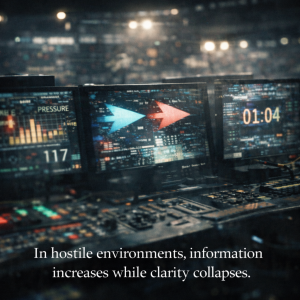
High-Noise Conditions
Hostile environments are defined by:
- overlapping signals without hierarchy
- rapid state changes
- false confirmations
- pressure that escalates without resolution
Noise replaces clarity, and participation becomes reactive rather than aligned.
The environment does not invite entry — it tests discipline.
Operational Contrast
Resistance vs Opportunity
Not every difficult environment is hostile.
- Opportunity environments challenge execution but reward alignment
- Hostile environments punish engagement regardless of intent
- The difference is whether structure responds to participation or resists it

When effort increases while clarity decreases, resistance is present.
PF-EV Application
PF-EV treats hostility as a disqualifier, not a puzzle to solve.
When signal integrity collapses and variance expands, non-participation preserves optionality.
The objective is not to out-guess chaos, but to wait for environments that permit structure to operate.
Discipline is measured not by action, but by restraint under pressure.